
Vergina (Greek: Βεργίνα, Vergína [verˈʝina]) is a small town in Northern Greece, part of the Veria municipality in Imathia, Central Macedonia. Vergina was established in 1922 in the aftermath of the population exchanges after the Treaty of Lausanne and was a separate municipality until 2011, when it was merged with Veroia under the Kallikratis Plan.
Vergina is best known as the site of ancient Aigai (Ancient Greek: Αἰγαί, Aigaí, Latinized: Aegae), the first capital of Macedon. In 336 BC Philip II was assassinated in Aigai’s theatre and his son, Alexander the Great, was proclaimed king. While the resting place of Alexander the Great is unknown, researchers uncovered three tombs at Vergina in 1977 – referred to as tombs I, II and III.
Tomb I contained Philip II, Alexander the Great’s father, tomb II belonged to Philip III of Macedon, Alexander the Great’s half-brother, while tomb III contained Alexander IV, Alexander the Great’s son.[2][3]
Tomb I had been looted; Tombs II and III were intact and contained an array of burial goods. The ancient town was also the site of an extensive royal palace. The archaeological museum of Vergina was built to house all the artifacts found at the site and is one of the most important museums in Greece.[4]
Aigai has been awarded UNESCO World Heritage Site status as “an exceptional testimony to a significant development in European civilization, at the transition from classical city-state to the imperial structure of the Hellenistic and Roman periods”.[4]
Archaeology
Archaeologists were interested in the burial mounds around Vergina as early as the 1850s, supposing that the site of Aigai was in the vicinity. Excavations began in 1861 under the French archaeologist Léon Heuzey, sponsored by Napoleon III. Parts of a large building that was considered to be one of the palaces of Antigonus III Doson (263–221 BC), partly destroyed by fire, were discovered near Palatitsa, which preserved the memory of a palace in its modern name. However, the excavations had to be abandoned because of the risk of malaria. The excavator suggested that this was the site of the ancient city Valla, a view that prevailed until 1976.[21]
In 1937, the University of Thessaloniki resumed the excavations. More ruins of the ancient palace were found, but the excavations were abandoned on the outbreak of war with Italy in 1940. After the war the excavations were resumed, and during the 1950s and 1960s the rest of the royal capital was uncovered, including the theatre.
The Greek archaeologist Manolis Andronikos became convinced that a hill called the Great Tumulus (Μεγάλη Τούμπα) concealed the tombs of the Macedonian kings. In 1977, Andronikos undertook a six-week dig at the Great Tumulus and found four buried tombs, two of which had never been disturbed. Andronikos identified that these were the burial sites of the kings of Macedon, including the tomb of Philip II, father of Alexander the Great (Tomb II) and also of Alexander IV of Macedon, son of Alexander the Great and Roxana (Tomb III). This view was challenged by some archaeologists,[22][23][24] and in 2010 research based on detailed study of the skeletons, vindicated Andronikos and supports the evidence of facial asymmetry caused by a possible trauma of the cranium of the male, evidence that is consistent with the history of Philip II.[25][26] From 1987 the burial cluster of the queens was discovered including the tomb of Queen Eurydice. In March 2014, five more royal tombs were discovered in Vergina, possibly belonging to Alexander I of Macedon and his family or to the family of Cassander of Macedon. Some artifacts excavated at Vergina may be treated as influenced by Asian practices or even imported from Achaemenid Persia in late 6th and early 5th centuries BC,[27] which is during the time Macedon was under the Persian sway.
In 2023, nearly 50 years later, a study led by professor of anthropology at the Democritus University of Thrace Antonios Bartsiokas ‘conclusively’ revealed that the skeleton long identified as belonging to Alexander IV of Macedon is in fact his father Philip II of Macedon, and vice versa: Tomb I contained Philip II, Alexander the Great’s father, tomb II belonged to Philip III of Macedon, Alexander the Great’s half-brother, while tomb III contained Alexander IV, Alexander the Great’s son.[28] Tomb I also contained the remains of a woman and a baby, who Bartsiokas identified as Philip II’s young wife Cleopatra Eurydice and their newborn child. Cleopatra Eurydice was assassinated along with her newborn child.[29]
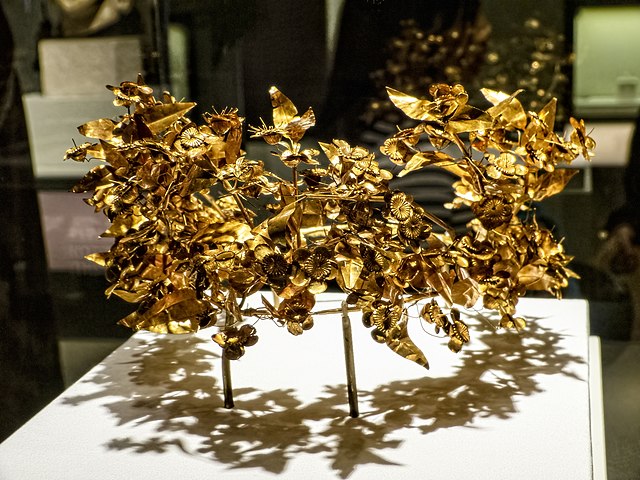
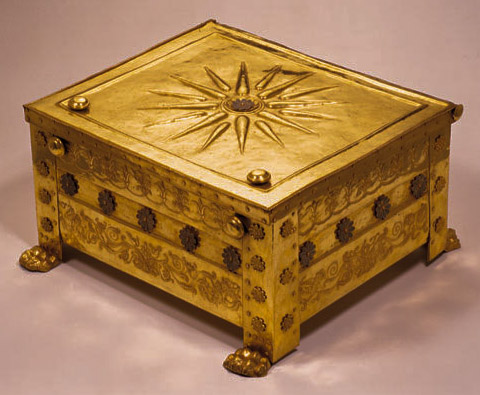
You should see, the golden larnax and the golden grave crown of Philip
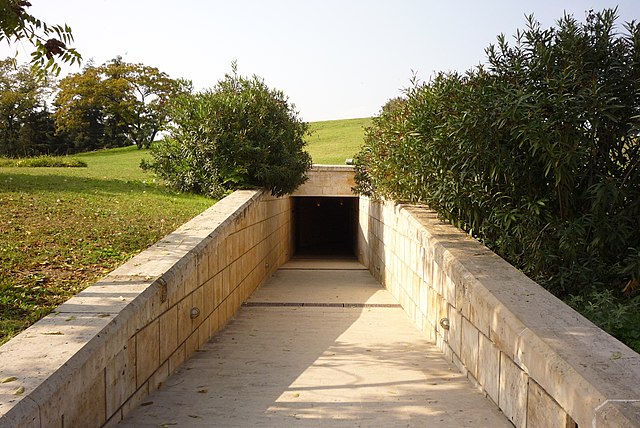
The Museum of the Royal Tombs of Aigai (Vergina) is located 75 km west of Thessaloniki, Greece, centered around the royal tombs built by the ancient Kingdom of Macedon at Aigai. The underground museum containing the burial cluster of Philip II of Macedon began construction in 1993 and was inaugurated in 1997. Exhibits are presented in four connected areas, including the Palace, the royal burial cluster of the Temenid dynasty (burial cluster “C”), the burial cluster of Philip II , and a gateway entrance with a semi-open-air exhibition of the sculptures found in the city sanctuaries and the restored upper floor of the Palace of Philip’s facade. The tombs and other archaeological sites of Aigai were inscribed on the UNESCO World Heritage List in 1996 because of its exceptional architecture and testimony to the transition between city-states and empires in European civilization.[1]
The collections housed in the museum are the grave goods recovered from archaeological excavations beginning in 1861 and continue to the present day.[2]
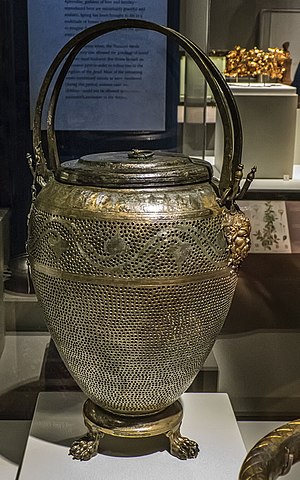
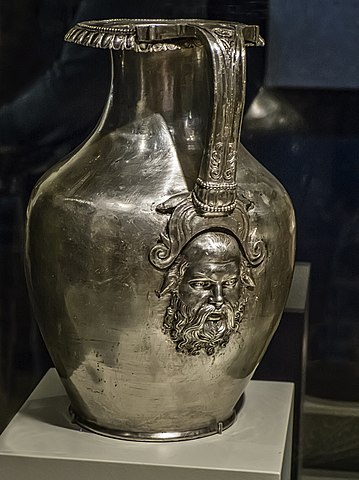
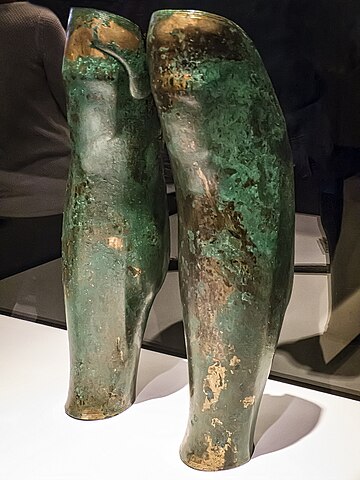
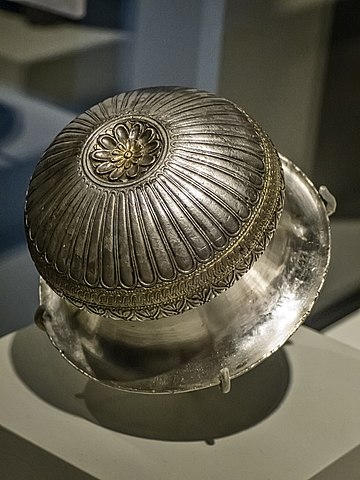
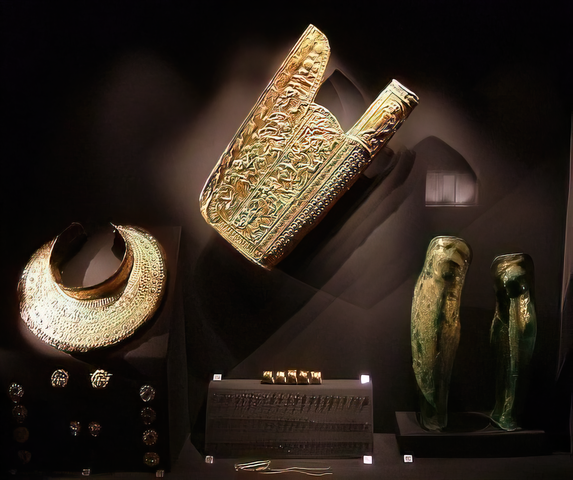
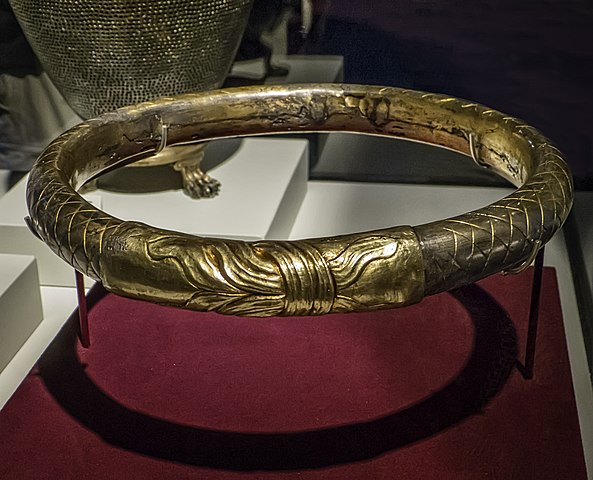
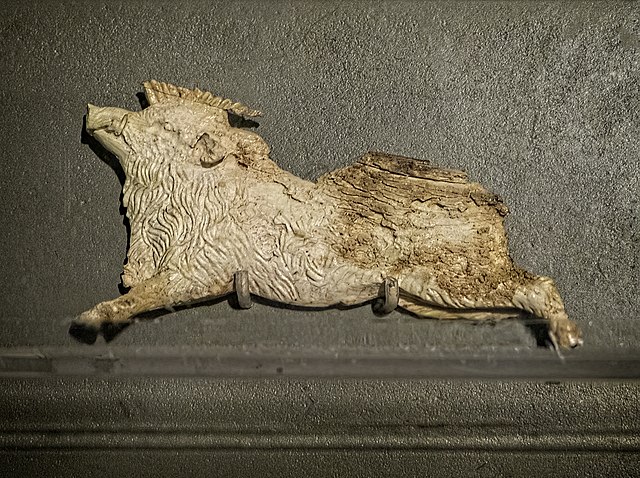
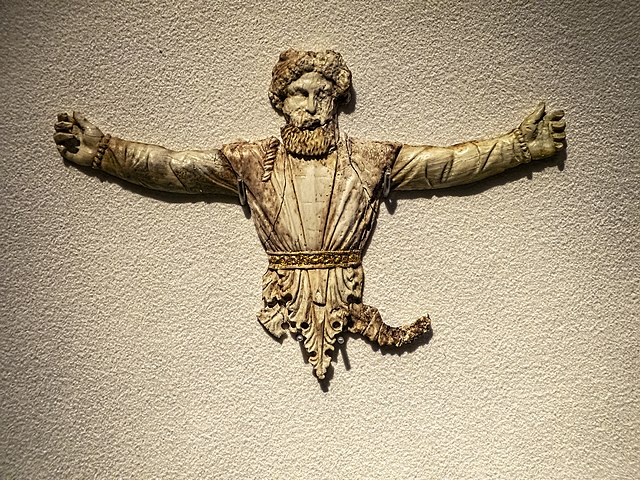
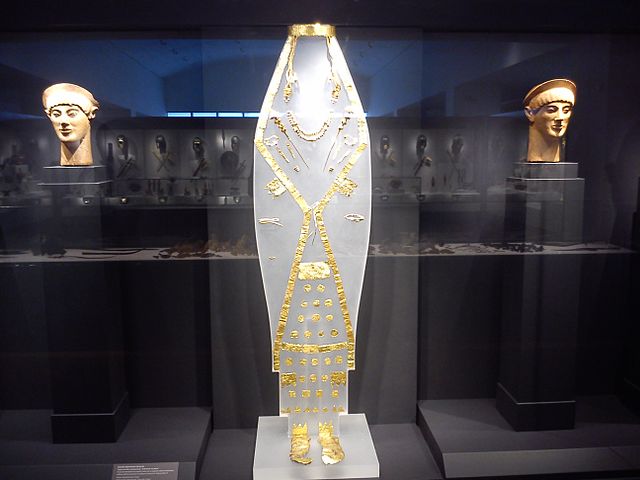
Among the objects found in the tomb of Philip II were a golden larnax emblazoned with the sixteen-rayed “Sun of Vergina” on its lid, containing the king’s bones, an intricate gold burial wreath, a silver and gold diadem with Heracles knot, silver and bronze vessels from the funeral feast, and carved ivory ornaments from the funeral couch. Gold armour and greaves with one custom fitted to Philip’s leg deformed by an improperly healed broken tibia, ivory inlaid shields, weapons, ivory reliefs, jewelry, and terracotta votive figurines were also found. Similar objects found in the other tombs, including the jewelry and body adornments from the 9th century BC “Lady of Aigai” are also presented.